

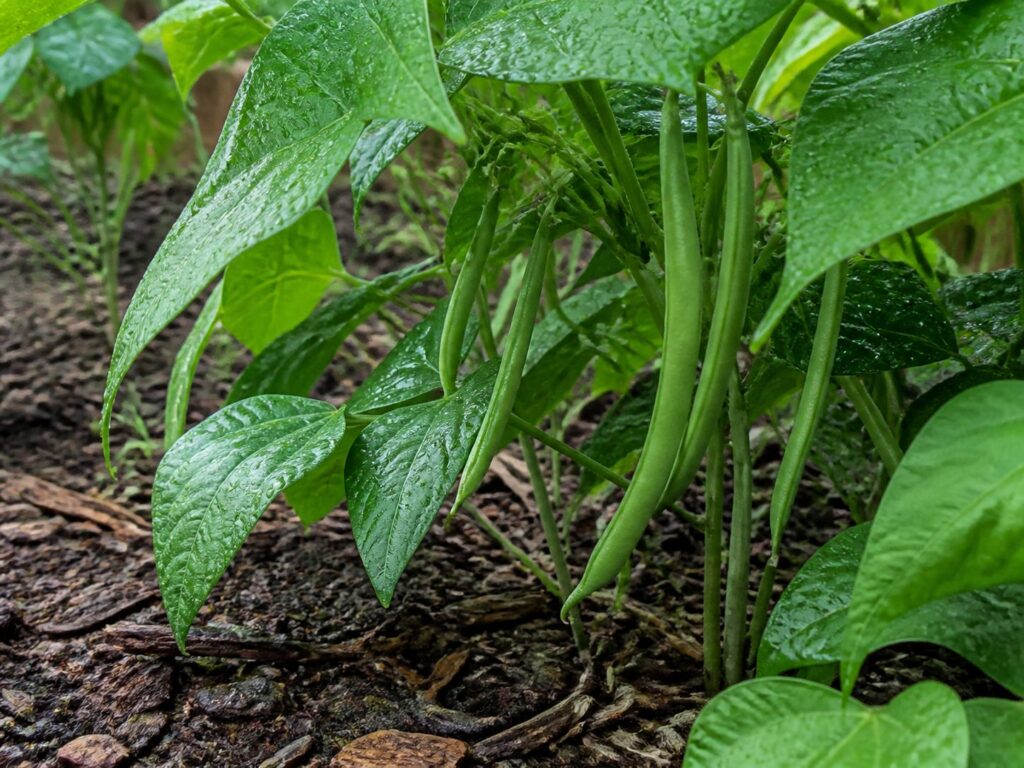
Green beans have shallow roots and soft pods, so watering is a balance: enough moisture to support flowering and pod fill, but never so much that roots remain saturated. Check the soil, weather, and growing method together instead of following a fixed daily schedule.
| Stage | Watering priority | What to watch |
|---|---|---|
| Germination | Keep the seed zone evenly moist | Do not let a surface crust form. |
| Leaf growth | Deepen watering as roots develop | Allow the surface to begin drying between sessions. |
| Flowering | Prevent drought swings | Dry soil can cause blossom drop. |
| Pod fill | Maintain steady moisture | Uneven water can produce tough or misshapen pods. |
How much is enough?
A useful starting point is about 1 inch of water per week from rain and irrigation, adjusted for heat, wind, soil, and container size. Water slowly at the soil line until the root zone is moist several inches down. Use a finger, trowel, or moisture meter to check rather than relying on the surface appearance alone.
Adjust for the garden type
Raised beds and containers warm quickly but can dry fast, especially along sunny edges. In-ground clay may hold water longer, while sandy beds need shorter intervals. Pole beans with a dense canopy can use more water than a small bush row. Drip irrigation or a soaker hose keeps leaves dry and delivers water where roots need it.
Mulch and timing
Mulch after soil has warmed, leaving a gap around stems. Organic mulch reduces evaporation and buffers temperature, but a thick wet layer against the crown can invite rot. Water in the morning so foliage that gets splashed can dry quickly. During a heat wave, check plants early and late rather than waiting for wilt.
Diagnose watering problems
Wilting in hot afternoon sun can be temporary; wilting in the morning suggests a deeper problem. Yellow leaves with wet soil point toward poor drainage or root damage, while crisp edges and dry soil indicate insufficient water. Flowers that drop after a dry spell may recover when moisture stabilizes. For a fuller diagnosis, read the flower and pod guide.
Do not compensate for dry soil with a sudden flood that erodes roots. Rewet slowly, then create a repeatable routine. Pair this guide with the complete growing guide and return to the Green Beans hub.

Adjust watering to the site
A starting point of about 1 inch of water per week from rain and irrigation works for many gardens, but sandy soil, wind, containers, and heavy pod loads change the schedule. Check the root zone several inches down. Water slowly at the soil line until moisture penetrates, then allow the surface to begin drying rather than sprinkling lightly every day.
Mulch after soil warms and keep it away from stems. Raised beds and containers often need more frequent checks than in-ground clay. Morning irrigation helps leaves dry. Wilting only in afternoon heat can be temporary; morning wilt, yellow leaves in wet soil, or a sour-smelling root zone deserves an inspection for drainage or disease.
Stable moisture supports flowering and pod fill but does not replace good light or fertility. Read the flower troubleshooting guide, the complete guide, and the Green Beans hub.
Use simple moisture checks
Push a finger or trowel several inches into the soil near, not against, the stem. If that zone is damp, wait; if it is dry and crumbly, water slowly until moisture reaches the root area. Repeat after rain because a wet surface can hide dry soil below. Record the routine so containers and bed edges receive the extra attention they need.
Stable moisture supports flowering but cannot replace sun or suitable fertility. Compare symptoms in the flower guide and return to the Green Beans hub.
Simple moisture check
Push a finger or trowel several inches into soil near, not against, the stem. Water when that zone is dry and crumbly; wait when it remains damp. Repeat after rain because a wet surface can hide dry soil below. Record rainfall and irrigation during flowering.
Use a simple moisture check
Push a finger or trowel several inches into soil near, not against, the stem. Water when that zone is dry and crumbly; wait when it remains damp. Repeat after rain because a wet surface can hide dry soil below. Containers may need daily checks in hot weather, while in-ground clay may need longer intervals.
Keep notes during flowering so you can distinguish water stress from light, variety, or fertility issues. Use the Green Beans hub for the next diagnosis.
Water for the root zone, not for a fixed schedule
Green beans need even available moisture, especially while seedlings establish and while plants are flowering and filling pods. The amount varies with soil texture, rainfall, wind, temperature, mulch, and container size. A commonly cited garden starting point is about an inch of water per week from rain plus irrigation, but it is a check-in point rather than a rule. Sandy soil and containers may need smaller, more frequent applications; heavier soil may need less frequent watering to avoid saturation.
Check moisture below the surface
Push a finger or narrow trowel a few inches into the soil beside, not through, the root zone. If the soil is dry below the surface where roots are active, water slowly enough that it soaks in rather than running off. If it is still wet and sticky, wait. The goal is damp, aerated soil—not a permanently wet surface.
| Situation | Helpful approach |
|---|---|
| Newly sown seeds | Keep the seed zone evenly moist until emergence without forming a crust. |
| Established bed in dry weather | Water deeply, then reassess before watering again. |
| Flowering or pod fill | Avoid sharp dry-to-wet swings; use mulch to slow evaporation. |
| Container beans | Check daily in heat; water until excess drains, then empty saucers if used. |
Choose timing and delivery carefully
Watering early in the day gives foliage time to dry if it becomes wet. Drip irrigation or a hose at the soil surface puts water where it is needed and makes it easier to measure. Overhead watering is not automatically harmful, but persistent wet foliage late in the day can favor disease in crowded plantings. Yellow leaves can result from too much or too little water, so check soil moisture and roots before increasing the schedule.
Practical growing decisions
Green beans need steady moisture, especially during establishment, flowering, and pod fill, but the right frequency depends on soil and weather. A rule such as “water every day” is less useful than checking the root zone. Sandy beds drain quickly; clay holds moisture longer; containers dry fastest; mulch can slow evaporation. Aim for even soil moisture without keeping the planting saturated.
| Condition | Useful response |
|---|---|
| Hot, windy weather | Check more often and water deeply before plants are stressed. |
| Sandy soil | Use smaller, more frequent deep waterings as needed. |
| Clay or slow-draining soil | Water less often and confirm the lower root zone is not wet. |
| Flowering and pod fill | Avoid dry-to-wet swings; mulch where appropriate. |
Common mistakes and useful adjustments
Avoid planting into cold saturated soil, crowding plants for the sake of one more seed, or reacting to every symptom with fertilizer. Keep a simple record of the variety, sowing date, weather, watering changes, and harvest quality. That makes it easier to distinguish a seasonal setback from a site or method problem.
Before you change care
Inspect more than one plant, check soil below the surface, and consider the recent weather. Change the clearest limiting factor first, then give the crop time to respond. Beans are resilient, but they do not benefit from repeated root disturbance or rapid swings between drought and saturation.
Dry soil may cause wilting in heat, slow growth, or tougher pods, but the same symptoms can appear when roots are stressed by waterlogging. Check below the surface before deciding. A hose left running at one point can wet only a narrow channel, while a fast application to dry soil can run off instead of soaking in. Water more slowly, move the hose along a row, or use drip irrigation if that is a recurring issue.
Mulch is useful after the soil has warmed and seedlings are established. It reduces splash and slows evaporation, but it is not a substitute for checking moisture. Keep mulch away from stems and do not pile it over a poorly drained bed. In wet weather, pause irrigation and improve access to the bed rather than compacting saturated soil by walking in it.
Keep a practical irrigation note
For one week, record rainfall, each irrigation, and the moisture a few inches down before watering. This small experiment reveals whether a rigid schedule is too frequent or too sparse for the actual soil. Adjust one interval at a time, especially during flowering and pod fill.
Adapt after rainfall rather than adding water automatically
Rain gauges are useful because a brief shower may wet leaves without reaching the active root zone. After rain, check soil depth before skipping or adding irrigation. In a mulched bed, the surface can look dry even when moisture remains below. In containers, a heavy shower can still miss the protected root zone under dense foliage, so check there as well.
Frequently asked questions
Should beans be watered every day?
Not necessarily. Water when the root zone begins to dry, with frequency adjusted for soil, rain, heat, and containers. A deep soak is usually more useful than a light daily sprinkle.
Can overhead watering damage beans?
Occasional rain is fine, but frequent wet foliage can encourage disease. Water at the soil line when practical and provide airflow.
