

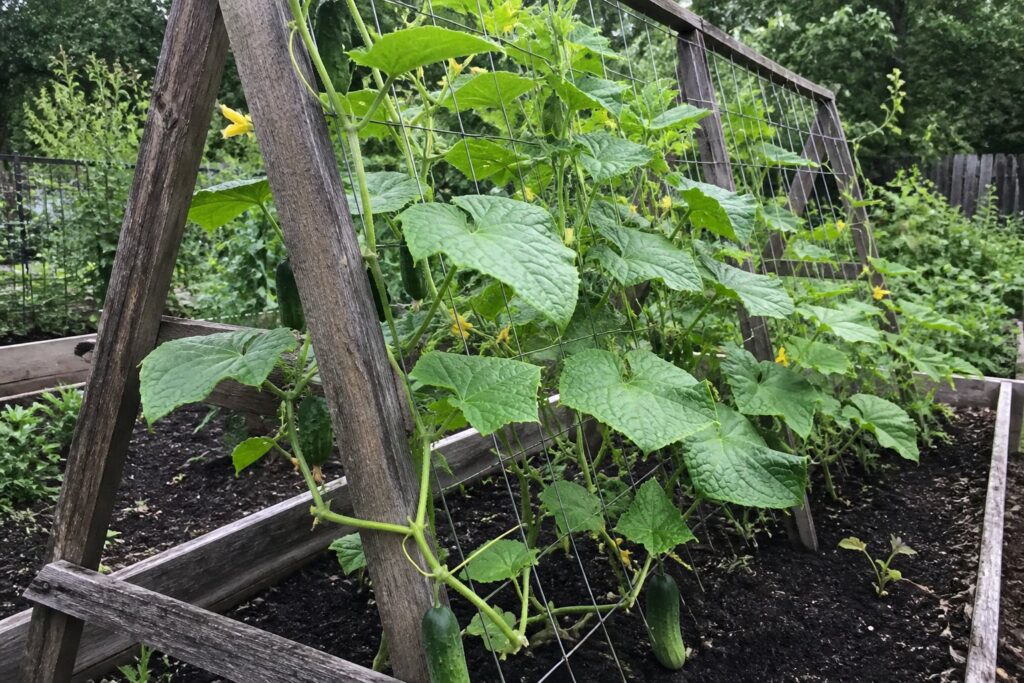
A cucumber trellis is more than a frame to hold vines. It changes how you water, inspect leaves, find flowers, and harvest fruit. A good support keeps foliage off wet soil, gives tendrils a route upward, and remains stable when a mature vine is carrying a heavy crop. The safest time to install it is before planting or while seedlings are still small.
This guide compares trellis styles, explains anchoring and training, and covers the mistakes that lead to collapsed supports or damaged vines. For the broader crop plan, see Growing Cucumbers: A Complete Guide; for fruit that fails to form, read Cucumber Flowers but No Fruit.
Why grow cucumbers vertically?
Vining cucumbers naturally search for support. Giving them one can reduce soil contact, improve air movement, simplify harvest, and make it easier to notice pests or disease early. Vertical growth can also reclaim ground space for a short companion crop. It is not automatically better for every variety: bush types may need only a small cage or no support, and a weak trellis is worse than a carefully managed ground vine.
| Potential benefit | What it changes | What still matters |
|---|---|---|
| Cleaner fruit | Less contact with damp soil and mulch. | Fruit can still rest against wet leaves or supports. |
| Easier picking | Fruit is more visible at eye level. | Harvest often so hidden fruit does not enlarge. |
| Air and light | Leaves can dry more quickly after rain. | Do not pack vines too densely. |
| Space efficiency | More ground remains available below. | Roots still need moisture and room. |
Choose a trellis style
Wire or netting panel
A rigid livestock panel, welded wire panel, or sturdy garden mesh gives tendrils many attachment points. It works well for a row of vining plants when both sides are accessible. Use openings that allow fruit to be removed without forcing it through a tiny square.
A-frame
An A-frame offers two sloping faces and can stand over a bed or path. It is useful where a flat wall would shade another crop. Anchor both legs and check that the center does not flex under vine weight.
String or vertical line
Vertical strings can suit a greenhouse or very orderly bed, but they require secure top and bottom anchors. Use weather-resistant line and inspect it after wind. A single strand should not be expected to carry a heavy vine without a reliable support structure.
Arch or fence
An arch creates a tunnel effect and can be attractive over a path. Make sure the arch is high enough for comfortable access and strong enough that fruit weight does not pull it into the walkway. Existing fencing can work if it is stable, clean, and positioned in full sun.
Build for mature weight and weather
Install posts deeper than seems necessary and brace the top if the structure can sway. Loose soil, wind, and wet foliage add stress. A trellis that survives a seedling is not necessarily ready for a full crop. Test it with a firm hand before vines climb; if it moves significantly, improve the anchor now.
Keep the bottom edge above the soil where possible. Direct contact with wet soil accelerates decay in wood and can let a support lean. Leave a working gap for watering and weeding. Do not place posts where they block the root zone of another crop or prevent access to the cucumber crown.
Train young vines gently
- Install the support before the vine needs it.
- Guide the main stem toward the lower openings or string.
- Use soft ties or clips loosely; stems thicken quickly.
- Let tendrils wrap naturally when they can.
- Redirect a vine a little at a time instead of bending a stiff stem sharply.
- Check every few days during fast growth.
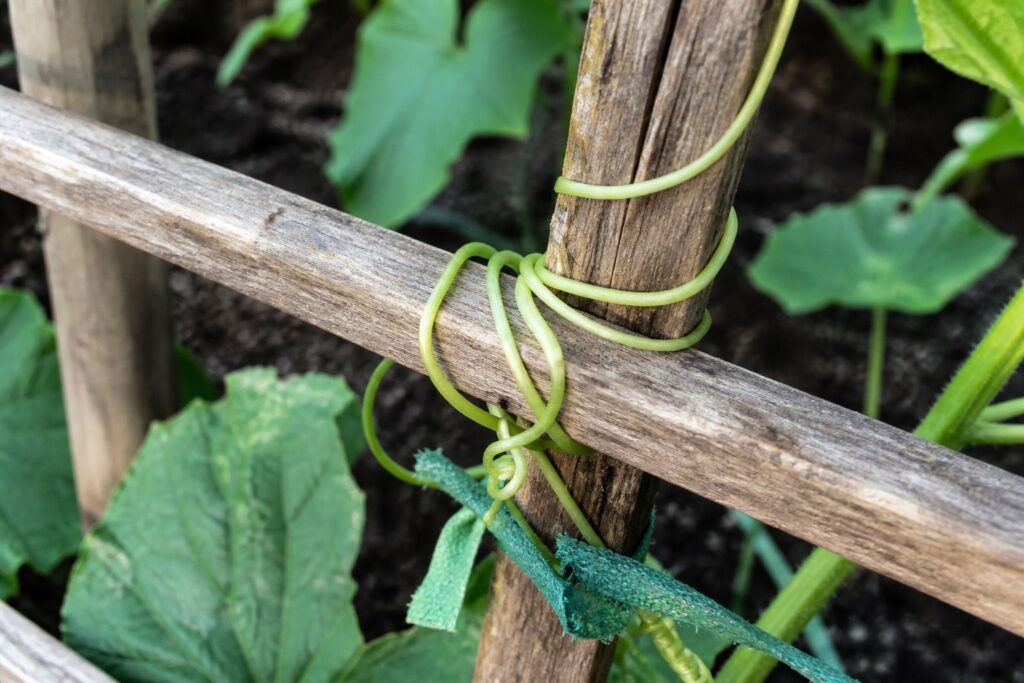
Tendrils can grip mesh well, but they may miss a smooth post or a wide gap. A loose tie gives early direction without strangling the stem. Do not tie fruit or leaf stalks tightly. If a vine slips, lift it gently and support the section rather than pulling from the growing tip.
Spacing and airflow
Vertical does not mean crowded. Follow the seed packet’s plant spacing and keep enough room around the base to water and inspect. Two vines trained into the same narrow panel can create a dense wall of foliage if light is limited. Prune only with a purpose—remove damaged or diseased material and clear a path, but do not strip healthy leaves simply to make the trellis look tidy.
In a humid garden, orient the trellis so prevailing airflow can move through foliage. Morning sun helps leaves dry after dew. A trellis against a hot reflective wall may need more frequent watering and afternoon relief.
Managing fruit on a trellis
Once vines climb, look beneath leaves for fruit that is ready. Small pickling cucumbers can be hidden in a dense canopy and grow past their best size quickly. Support heavy fruit only if the variety needs it; avoid tying fruit in a way that constricts the stem. If a cucumber hangs through a mesh opening, harvest it before its weight distorts the vine.
Check that fruit is not rubbing constantly against rough wire or a sharp edge. Padding is usually unnecessary on a smooth support, but a damaged fruit is a reason to adjust the vine or improve the opening.
Common trellis problems
| Problem | Likely cause | Fix |
|---|---|---|
| Frame leans | Shallow posts, loose soil, or wind. | Brace or reset before the canopy grows heavier. |
| Vine falls away | Openings too wide or surface too smooth. | Add soft ties or a closer mesh route. |
| Base becomes crowded | Too many plants at one point. | Thin early and keep a clear watering zone. |
| Leaves stay wet | Poor airflow, dense canopy, overhead watering. | Improve spacing and direct water to soil. |
| Fruit is misshapen | Pollination, water stress, variety, or contact pressure. | Check the pollination and watering guides before pruning harder. |
Ground growing versus climbing
If you do not have a stable support, let the vine run on clean mulch and give it room. A ground vine can be productive, but harvest access becomes harder and leaves may remain damp longer. Never force a variety onto a trellis simply because vertical growing is fashionable. Choose the system that you can anchor, water, and inspect through the whole season.
Build support before the vine needs it
A cucumber trellis is a small piece of infrastructure, but it carries a surprising amount of wet foliage and fruit. Set posts at least 12 inches into firm soil, place the support where it will not shade shorter crops, and leave a little clearance for tying and harvesting. For a row, a 5–6 foot trellis is a practical starting height for many vining varieties. Use a stronger frame for large fruit or windy sites, and check it after heavy rain.
| Support type | Good fit | Watch for |
|---|---|---|
| A-frame | Two rows or a narrow bed | Anchor both feet so the frame cannot splay. |
| Vertical mesh | Single row against a fence | Use openings small enough for tendrils to grip. |
| String trellis | Light vining varieties | Replace sagging twine and keep the base clear. |
| Cage or arch | Bushier plants and containers | Provide enough diameter for fruit to hang freely. |
A gentle training schedule
When the main stem is 8–12 inches tall, point it toward the support rather than bending it sharply. As tendrils appear, wrap them around mesh or secure the stem loosely with soft ties. Check twice a week during rapid growth. A tie should support the vine without cutting into it; leave room for the stem to thicken. If a side shoot escapes, guide it back while it is flexible instead of pulling mature foliage through the mesh.
Pruning is optional and variety-specific. Removing yellow leaves and crowded, damaged growth improves access, but stripping healthy leaves can expose fruit to sun and reduce the plant’s energy supply. If your plant has many flowers but few cucumbers, combine sound support with the pollination troubleshooting guide. For site and spacing decisions, see the complete guide and the Cucumbers hub.
Maintenance and safety checks
- Push or tie loose posts back into firm soil after storms.
- Keep sharp wire ends folded or capped.
- Harvest from both sides of an A-frame so fruit is not hidden.
- Disinfect tools between plants when removing damaged tissue.
- Do not use a rigid tie directly around a growing stem.
Frequently asked questions
How tall should a cucumber trellis be?
Make it tall enough for the variety and comfortable harvest access. Many home supports fall in the roughly five- to seven-foot range, but a compact variety needs less and a heavy vine needs a stronger structure, not just more height.
Do cucumbers need help climbing?
Often at the start, yes. Guide young stems and use loose ties where tendrils cannot catch. Once attached, inspect growth regularly instead of pulling mature vines into place.
Can I trellis bush cucumbers?
A small cage can keep fruit and foliage organized, but bush types may not need a tall structure. Follow the variety’s growth habit.
Return to the Growing Cucumbers hub for planting, watering, pollination, and harvest resources.
Additional questions
Do cucumbers climb on their own?
Tendrils grip well when they contact a narrow mesh, string, or rough support. They may not hold a wide, smooth pole, so guide young growth and add a loose tie where needed.
Can I trellis bush cucumbers?
You can give a bush variety a short cage or low support to keep fruit off wet soil. It usually does not need the tall structure intended for a long vining type.
