

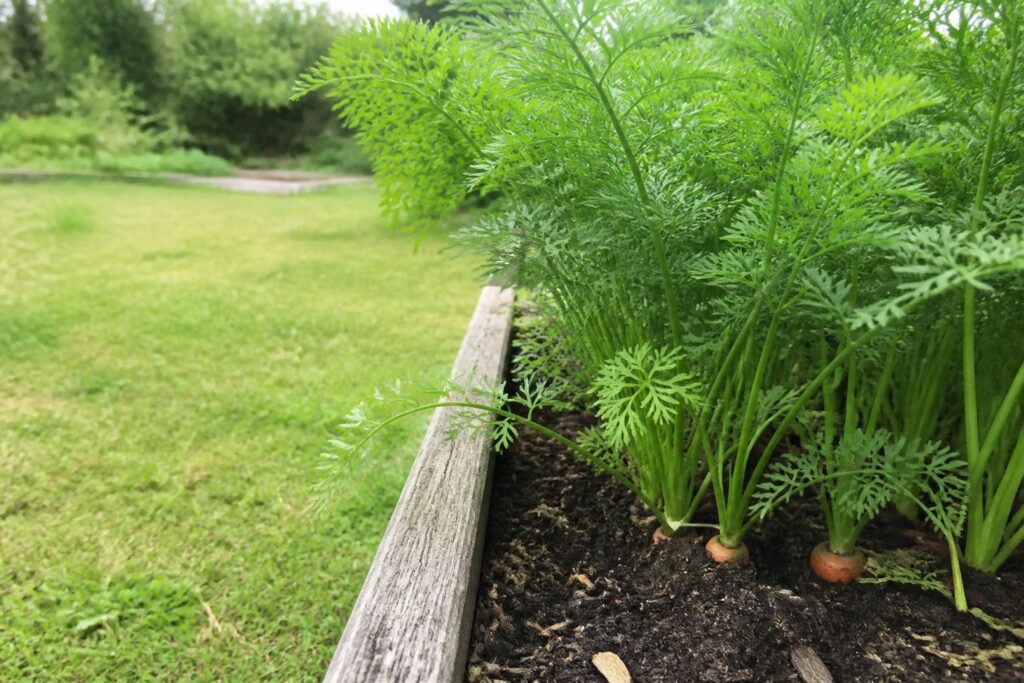
Carrots are easiest to grow when their roots can travel straight through loose soil and the seedbed stays evenly moist while germination begins. They are usually direct-sown rather than transplanted: the young taproot is easily disturbed, and a disrupted root can make a crooked or forked carrot later. The reward for that little patience is a crop that works in a small garden, a raised bed, or a deep container.
This guide focuses on the practical decisions that matter most: preparing a fine seedbed, sowing shallowly, watering without crusting the surface, thinning on time, and harvesting in a flexible window. For help choosing a date, see When to Plant Carrots; for a close look at final distances, use the Carrot Spacing Guide.
Start with a site that suits roots
Choose a bed that receives roughly six or more hours of direct sun. Carrots can tolerate a little shade, but a sunnier site generally supports steadier growth. More important than perfect soil fertility is soil structure. A root needs a loose, deep route with few stones, clods, old roots, or compacted layers. In a shallow or stony bed, choose a shorter, blunt-ended variety rather than expecting a long type to force its way through an obstacle.
Work the bed when it is crumbly rather than wet and sticky. Remove rocks and undecomposed woody material, then loosen the soil deeper than the mature root length you hope to grow. Finished compost can improve texture and moisture-holding capacity, but avoid creating a rich pocket of fresh manure directly where roots will form. Uneven fertility and physical obstacles can encourage branching. The soil guide for carrots explains how to improve a difficult bed without overworking it.
| Before sowing | Why it helps | Practical check |
|---|---|---|
| Loose, fine surface | Small seed can emerge without fighting a crust. | Break clods and rake the top inch or so smooth. |
| Stone-free root zone | Roots are less likely to split or bend around obstacles. | Remove rocks as you prepare the bed. |
| Even moisture available | Carrot seed germinates slowly and should not dry out. | Choose a bed you can check often. |
| Reasonable depth | Root shape is less restricted. | Match variety length to bed depth. |
When to sow carrot seed
Carrots are a cool-season crop. In many climates, seed can go into workable garden soil in spring, with further sowings made through the season while there is enough time for the chosen variety to mature. Instead of relying on one calendar date, use the local last-frost pattern, soil condition, expected heat, and the days-to-maturity range on the packet. Warm summer soil can slow or uneven germination, so late plantings often benefit from closer attention to moisture and light shading of the soil surface.
A small succession sowing every two to four weeks is often more useful than one oversized planting. It spreads harvesting and gives you a second chance if the first seedbed crusts, dries out, or is thinned poorly. Stop sowing when the likely harvest window would run into severe heat, hard freezing, or the end of your usable season. For a season-by-season planning approach, read When to Plant Carrots.
How to sow carrots from seed
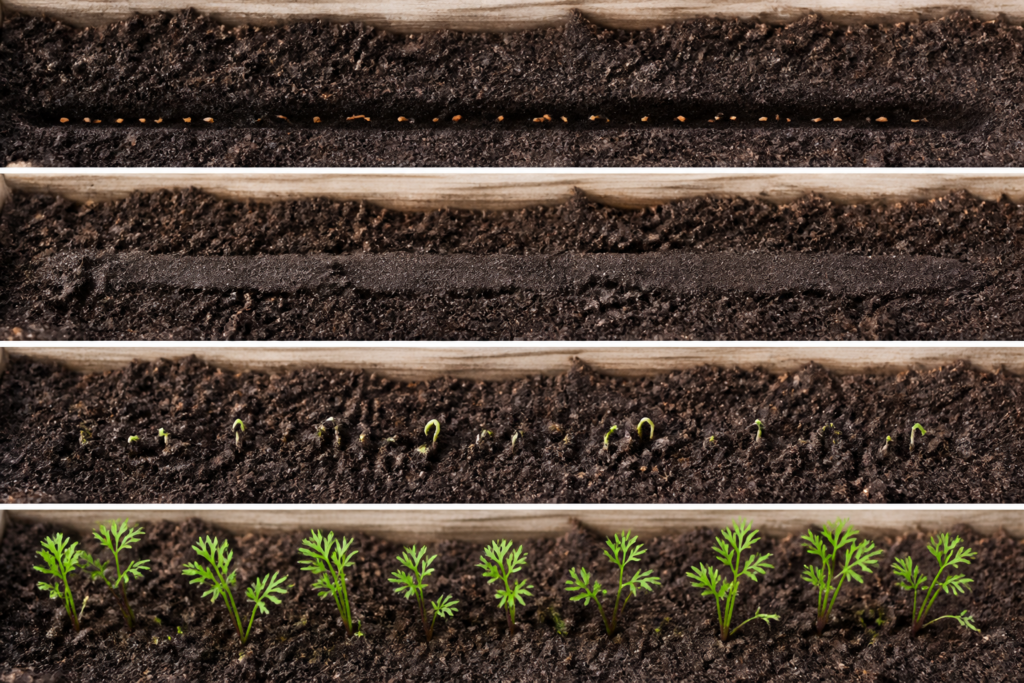
- Mark shallow rows or bands. For row gardening, leave enough room to weed and water between rows. In a wide raised bed, short rows or evenly spaced bands can use the surface efficiently.
- Sow thinly. Seed is tiny, so it is normal to over-sow a little. Aim for a light scattering rather than a solid line; thinning later is part of the method.
- Cover lightly. About one-quarter to one-half inch is a common starting range. Use fine soil, screened compost, or another light material that seedlings can push through. Planting too deeply is a frequent cause of weak, uneven emergence.
- Firm gently. Press the surface lightly for seed-to-soil contact without making a hard crust.
- Water with a soft spray. Soak the shallow seed zone without washing seed into piles or forming channels.
- Label the row. Include the variety and sowing date. This makes maturity timing and future comparison much easier.
Carrots may take one to three weeks to appear, depending on soil temperature and conditions. During that interval, the top layer is the priority. Check it often; it should stay moist, not waterlogged. A very hard crust after rain can stop delicate seedlings. If crusting is common in your soil, use a finer covering material at sowing time and water more gently.
Thin for the carrot size you want
Thinning can feel wasteful, but crowding is one of the main reasons a row produces thin roots instead of useful full-sized carrots. Begin when seedlings are large enough to handle and you can see where the crowded clusters are. Make an early thinning so surviving plants are no longer pressed together, then make a final thinning after the plants have more true leaves. Many standard carrots finish best around two to three inches apart; petite varieties may be closer and very large types may need more room. The packet is the final authority for the variety you chose.
Pulling seedlings can disturb neighbors in loose soil. Where that is a concern, snip unwanted seedlings at soil level with clean scissors. Water afterward if the top layer has been disturbed. The detailed spacing guide includes examples for rows, blocks, and containers.
Care from emergence to harvest
Once plants are established, shift from “keep the surface damp” to “keep moisture reasonably even through the root zone.” Carrots do not need a fixed calendar watering schedule. Sandy soil dries faster than loam, containers dry faster than in-ground beds, and rain changes the plan. Water deeply enough to moisten the developing root zone, then check before watering again. Repeated swings from very dry to suddenly saturated soil can contribute to cracking and uneven growth.
Weed early and carefully. Carrot foliage is slow to form a dense canopy, so weeds can take light, water, and nutrients before seedlings gain size. Use a hand tool shallowly between rows and avoid digging into the carrot row. A light organic mulch after seedlings are established can help conserve moisture, but keep it thin enough that the row remains easy to inspect and does not trap slugs in a damp climate.
Fertilizer should support the soil test and the product label, not a guess that more nitrogen means a larger root. Excessively lush tops are not a reliable sign of better carrots. If growth is weak, first check spacing, compaction, moisture, weeds, and whether the bed received enough sun. For root-shape problems, see Why Carrots Grow Forked or Misshapen.
Common early problems
| What you see | Likely contributors | Next step |
|---|---|---|
| Patchy emergence | Dry surface, deep sowing, crusting, old seed, cold or hot soil. | Keep the seed zone moist; re-sow gaps if the season allows. |
| Seedlings falling over | Heavy watering, disturbance, or disease favored by persistently wet conditions. | Improve gentle watering and avoid keeping soil saturated. |
| Many pencil-thin roots | Crowding or competition from weeds. | Thin to the variety’s final spacing and weed carefully. |
| Green shoulders | Top of the root exposed to light. | Pull a little loose soil or mulch around exposed shoulders. |
Harvest with the variety in mind
Days to maturity are an estimate, not a deadline. Begin checking when the packet’s range approaches and the top of a few roots looks broad enough for the type. Gently brush soil away from one shoulder rather than pulling a whole row too soon. Smaller carrots can be tender and useful; leaving a healthy planting longer may increase size, but only while the roots remain in good condition.
Watering lightly before harvest can make a dry bed easier to work, but do not turn it into mud. Loosen soil beside a root with a hand fork or trowel and lift rather than pulling hard on foliage. Twist or cut off leafy tops soon after harvest if you plan to store roots, because the leaves continue to draw moisture from them. For handling and storage details, read When and How to Harvest Carrots.
Practical takeaways
- Direct-sow carrots into a smooth, shallow, consistently moist seedbed.
- Match root length to the depth and texture of the bed.
- Thin in stages; final spacing is a crop-management step, not an optional tidy-up.
- Keep moisture even rather than alternating drought and flooding.
- Harvest by checking size and condition, not only a number of days on a packet.
Use the Vegetable Plant Spacing Calculator when turning a carrot bed into a practical planting plan.
Frequently asked questions
Should carrot seed be started indoors?
Usually no. Carrots are commonly direct-sown because transplanting can damage or bend the young root. If space is limited, grow a shorter variety in a sufficiently deep container instead.
Can I sow carrots with radishes as row markers?
Some gardeners use a quickly germinating crop such as radish to show a row before carrots emerge. Keep the marker crop sparse and harvest it promptly so it does not compete with the carrots. It is an optional management technique, not a requirement.
Why did only some seeds germinate?
Carrot emergence is sensitive to the condition of the shallow seed zone. Uneven moisture, a soil crust, variable planting depth, temperature, and seed age can all produce gaps. Re-sowing a short gap is often simpler than trying to nurse a thin patch along.
Return to the Growing Carrots hub for the full set of practical carrot guides.
