

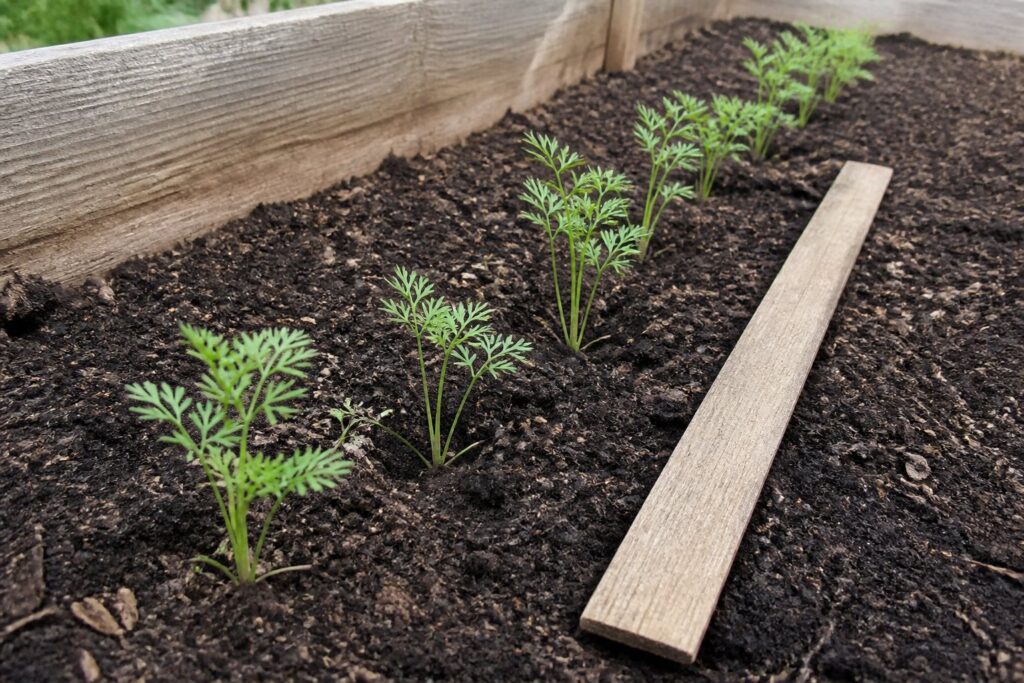
Carrot spacing is the quiet difference between a row of useful roots and a row of crowded, pencil-thin carrots. Seed is small, germination is never perfectly even, and a freshly sown row often looks too empty. That is why carrot spacing happens in stages: sow a little more densely than the final distance, then thin seedlings so every remaining root has room to enlarge.
The right final distance depends on the variety, the size you want, and the planting method. Two to three inches apart is a useful common range for many standard carrots, but the seed packet should lead when it specifies something different. This guide shows how to turn that range into an easy plan for rows, blocks, and containers. For the complete crop sequence, start with Growing Carrots From Seed.
Three different distances to understand
| Distance | What it means | Typical purpose |
|---|---|---|
| Seed spacing | How close seed lands at sowing. | Allows for imperfect germination; often about an inch apart when practical. |
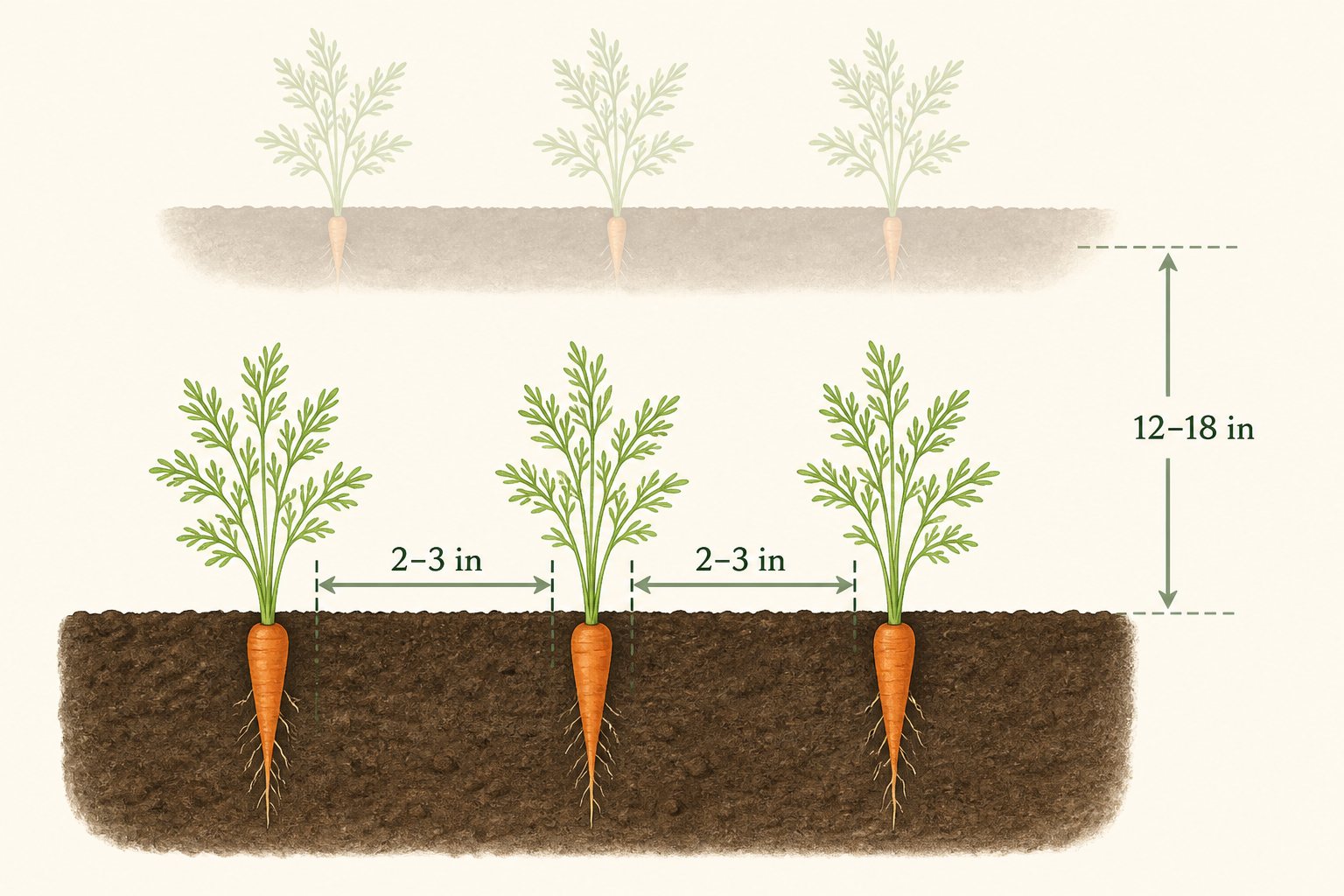
| Final plant spacing | Distance between the carrots you keep. | Often around two to three inches for standard roots; follow the variety packet. |
| Row spacing | Clear space between rows or bands. | Creates room for light, water, thinning, and shallow weeding. |
Do not confuse seed spacing with final spacing. If you sow every carrot seed precisely two inches apart, you may get gaps where seed fails to germinate. If you sow heavily and never thin, you may get many small roots. The practical middle path is light, shallow sowing followed by deliberate thinning.
Plan the layout before you sow
Rows are easy to mark, water, and weed. In a traditional garden, leave a path or tool-width gap between rows so you can work without stepping on the root zone. In a raised bed, a block layout can use space efficiently: make several short, evenly spaced rows across the bed, then reach them from paths outside the bed. Containers work best with short varieties and a simple grid or band plan that leaves enough room to thin.
| Growing method | Layout idea | Spacing reminder |
|---|---|---|
| In-ground rows | One or more straight rows with a workable gap between them. | Keep final roots two to three inches apart unless the packet says otherwise. |
| Raised-bed block | Several short rows or bands across a bed you can reach from the sides. | Leave enough cross-space to weed without compacting soil. |
| Container | Short rows or an even grid in a wide, deep pot. | Use a shorter variety and do not crowd the container edge. |
How to thin carrots without creating a mess
Begin thinning when seedlings are big enough to identify and you can see dense clumps. Make an early pass to remove obvious crowding. Later, when remaining plants have a few true leaves, make the final thinning to the intended distance. This staged approach is easier than waiting until every seedling is tangled and competing.
- Water lightly first if the surface is dry and loose enough that pulling will disturb neighbors.
- Look for clusters and decide which seedlings are strongest and best positioned.
- Snip extras at soil level with clean scissors when pulling would tug nearby carrots.
- Check the final gap with your fingers, a small ruler, or a marked stick.
- Water gently afterward if thinning has disturbed the surface.
- Weed around the remaining plants while the row is open and easy to see.
It is tempting to delay thinning because the little plants look productive. The crop does not benefit from that delay. Crowded leaves shade each other, roots compete, and the final harvest may be uniformly narrow. Use thinnings as a kitchen garnish only if they are clean and large enough to be useful; do not feel obliged to save every tiny seedling.
Choose spacing for the result you want
Closer final spacing can produce smaller, more uniform roots and may suit a short variety or a baby-carrot harvest. Wider spacing can give larger roots more room, especially in loose soil and a long enough season. Neither choice fixes a hardpan, stone, or watering problem, so treat spacing as one part of the system. For root-shape diagnosis, see Why Carrots Grow Forked or Misshapen.
| Goal | Spacing approach | Trade-off |
|---|---|---|
| Small, tender carrots | Use the closer end of the packet range. | Roots may stay smaller; thinning must still be even. |
| Standard fresh roots | Use roughly two to three inches for many varieties. | Adjust for the packet and soil conditions. |
| Large or long types | Use the wider end of the recommended range in deep loose soil. | Requires more bed area and a longer suitable season. |
Visual reference for a simple row
Think of the finished row as a repeating pattern, not a crowded ribbon of green: carrot — two to three inches — carrot — two to three inches — carrot. Place adjacent rows far enough apart that foliage can receive light and you can reach the soil between them. In a raised bed, repeat the pattern across the bed only while you can still weed and harvest from its edge.
Newly sown seed will not look like this. It may begin much closer together, with some gaps. The visual goal appears after thinning. If you are unsure whether a row is crowded, look at leaf overlap and measure a short section. A marked stick with one-inch, two-inch, and three-inch marks removes guesswork.
Spacing problems and solutions
Too many seedlings in one clump
Thin early, choosing one plant every couple of inches. If the clump is tightly intertwined, snip rather than pull. Do not wait for roots to size up before making room.
Large empty gaps
Gaps can come from dry soil, a crust, uneven seed depth, pests, or old seed. If the season allows and the gap is substantial, re-sow it promptly. A late re-sown patch may mature later, so label it rather than expecting it to match the original row.
Roots are thin even after thinning
Check sun, soil depth, weeds, moisture, and variety. Spacing cannot compensate for hard soil or a variety naturally bred for small roots. The soil guide helps identify root-zone limits.
Rows are impossible to weed
They were probably placed too close together or seed was scattered too widely. Next time mark rows or narrow bands before sowing and leave an intentional working gap.
Spacing in containers and raised beds
In containers, edges dry faster and roots near the wall may have less consistent conditions. Keep the outer row slightly in from the rim and use a short variety suited to the depth. In raised beds, do not treat every square inch as plantable if it makes access impossible. A slightly less crowded layout that can be thinned and weeded usually produces a better harvest than a maximized grid left unmanaged.
Method choice affects spacing practicality, too. A deep pot may use a tidy grid; a broad raised bed may use short rows; an in-ground row may need wider paths. Compare the systems in Containers, Raised Beds, or In-Ground Carrots.
Use a spacing tool, not your memory
A small ruler, a marked plant label, or a stick with two- and three-inch marks makes thinning faster and more consistent. Measure a short section after the first pass; if the remaining plants are still touching, make a second pass before roots begin to swell. This is especially useful in a raised-bed block, where a dense patch can look acceptable from above but leaves no room below the surface.
When you thin, take a step back and inspect the whole row rather than fixing only the tightest clump. Even spacing across the bed supports more uniform harvest timing and makes it easier to spot weeds or gaps.
Spacing and succession planting
Each new sowing needs its own finished spacing. Do not tuck a second carrot crop into gaps around mature roots; it will be shaded and difficult to water. Instead, reserve a neighboring section or wait until an earlier planting is harvested, then prepare a fresh seedbed and start again.
Final reminder
Spacing is easiest to correct while seedlings are small. Thin early, check again later, and let the plants you keep have the room promised by the seed packet.
Measure once during thinning, then trust the pattern you have created.
That final check helps keep the whole row even.
Measure the finished stand, not the seed line
Spacing is successful when the roots you keep have the intended final room. A slightly uneven seed line is normal; corrected thinning creates the useful pattern. Check a few locations in the row, including the ends and any dense patches, before deciding the job is finished.
Use the Vegetable Plant Spacing Calculator as a starting point when planning a carrot bed.
Frequently asked questions
How far apart should carrots be thinned?
Many standard carrots finish around two to three inches apart, but variety labels vary. Use the packet’s recommendation when available and leave more room for larger root types.
Can I grow carrots in a square-foot garden?
Yes, if the bed has enough depth, the soil is loose, and you can maintain final spacing without compacting the surface. Plan a grid that you can reach from paths and adjust for the variety rather than forcing a fixed number of plants.
Should I thin after rain?
Lightly moist soil can make thinning easier, but avoid working a saturated bed. If pulling would disturb neighbors, snip seedlings at the soil line instead.
Return to the Growing Carrots hub for the complete guide set, including when and how to harvest carrots once your well-spaced crop is ready.
