

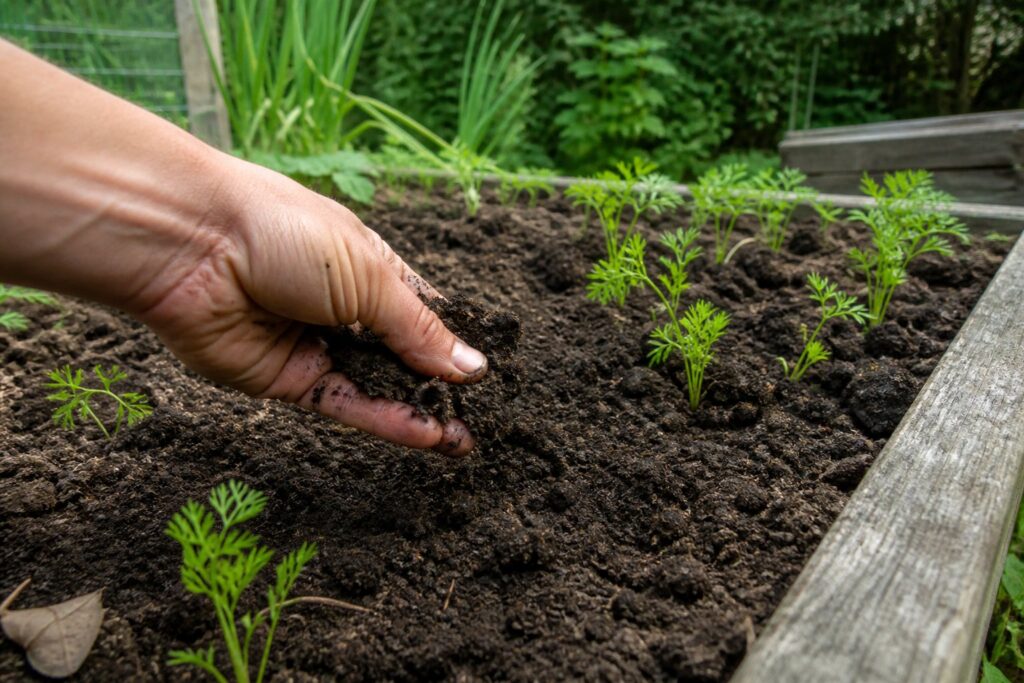
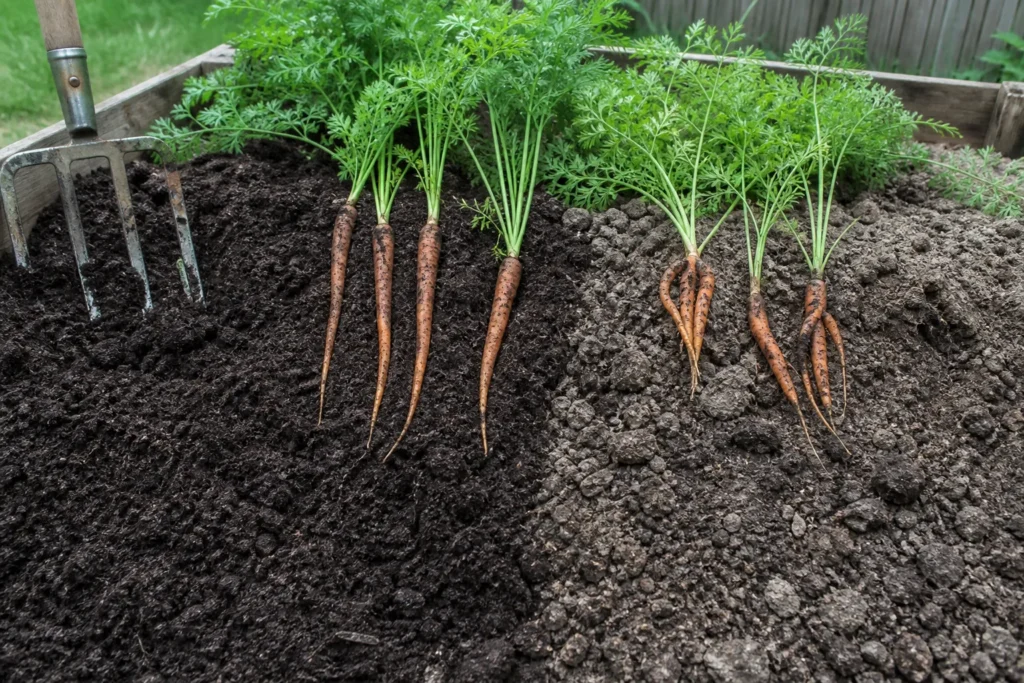
Carrots do not need an exotic soil recipe. They need a root zone that is loose, deep enough for the variety, reasonably fertile, well drained, and able to hold moisture without staying soggy. A carrot tells the story of the soil as it grows: stones can produce forks, dense layers can stop length, uneven moisture can lead to cracks, and a rough seedbed can prevent seedlings from emerging evenly.
The aim is not to make every bed identical. It is to understand what your soil does now and make the few changes that matter most for a direct-seeded root crop. If you are deciding whether a difficult site belongs in a container, raised bed, or ground bed, compare the options in this growing-method guide.
What good carrot soil looks like
n
n
A good carrot bed feels crumbly when moist, not like sticky putty or dry gravel. It contains enough fine material for seed-to-soil contact and enough larger pore space for water and air to move. It is not required to be perfectly sandy. Loam and improved clay soils can grow excellent carrots when they are not compacted and when the root zone has been prepared deeply enough.
| Soil trait | What carrots need | Simple field check |
|---|---|---|
| Depth | Loose soil at least as deep as the variety’s expected root length. | Use a trowel or fork to find dense layers and buried debris. |
| Texture | Fine enough for small seed, open enough for roots. | Moist soil should crumble instead of smearing. |
| Drainage | Moist but not saturated root zone. | Notice where puddles persist after rain. |
| Fertility | Balanced nutrients based on soil and crop need. | Use a soil test when possible. |
| pH | Slightly acidic to near-neutral is commonly suitable. | Use a local soil test rather than guessing from plant appearance. |
Prepare the bed before sowing
Begin before the seed packet comes out. Work soil when it is neither saturated nor powder-dry. Remove stones, thick roots, construction debris, and large chunks of unfinished organic matter from the expected root zone. Loosen compacted soil with a fork or broadfork rather than repeatedly pulverizing it with a tiller. The goal is a continuous path for roots, not a fluffy surface over a hard pan.
Rake the top layer smooth only after the deeper work is complete. Carrot seed is small and is usually planted about one-quarter to one-half inch deep. A cloddy surface creates irregular planting depth and pockets that dry out at different rates. Screened compost or fine garden soil can make a useful light covering over seed in a bed that tends to crust.
Use compost thoughtfully
Finished compost is often helpful because it can improve tilth and moisture-holding capacity. Spread it evenly and mix it into the upper soil rather than placing rich piles under individual seed rows. A little improvement made consistently over seasons is more useful than a one-time attempt to transform heavy soil overnight.
Do not use fresh manure in a carrot planting area. Beyond the food-safety issues associated with a crop that grows in soil and is often eaten raw, fresh or unevenly decomposed material can create an irregular root zone. If you use manure in a garden system, follow local food-safety guidance and allow appropriate time before harvesting root crops. When in doubt, use finished compost from a reliable source and wash harvested roots well.
Fertilizer: test first, then keep it balanced
Carrots need nutrients, but they are not improved by indiscriminate feeding. A soil test is the best way to learn whether phosphorus, potassium, lime, or another amendment is actually needed. Follow the testing lab or local extension recommendation and product label. Nitrogen supports leaf growth, but applying too much without a known deficiency can produce lush tops without solving root quality.
When a test is not available, focus first on good soil structure, adequate sun, even moisture, and sensible spacing. Those basics often explain disappointing roots more clearly than a missing fertilizer. If you do apply a labeled garden fertilizer, distribute it evenly, keep it out of direct contact with seed, and avoid piling it in the row. Good seed placement and thinning are covered in the seed-starting guide.
Handle common soil types
Heavy clay
Clay can hold water and nutrients well, but it may compact and form a surface crust. Avoid working it wet. Add finished compost gradually, keep pathways off the growing area, and consider a raised bed if the native soil remains shallow or dense. Do not assume that adding a small amount of sand will fix clay; the wrong proportions can create an even denser mix.
Very sandy soil
Sandy soil is easy for roots to travel through but dries and loses nutrients quickly. Add organic matter to increase water-holding capacity, monitor moisture below the surface, and use mulch after seedlings establish. Frequent tiny surface waterings are less useful than watering enough to moisten the root zone when it needs it.
Rocky or shallow soil
Choose a short-root variety, build a deeper raised bed, or use a deep container. Trying to grow a long carrot in a six-inch rocky layer is likely to yield forks and stubs, not because the seed was poor but because the site does not match the root.
Previously compacted lawn or path edge
Loosen deeply before planting, then avoid stepping on the prepared bed. Define access paths and use boards if you must reach across a wide bed. A single season of careful bed management can improve a compacted area, but repeated organic-matter additions and no-compaction habits improve it further over time.
Water and soil work together
Soil preparation is not finished when you sow. The same bed can be ideal in spring and stressful in a dry summer if moisture swings are extreme. During germination, keep the shallow seed zone moist. Once plants are established, water according to soil texture, rainfall, and container or bed type. Aim for steady moisture through the developing root zone rather than a cycle of drought followed by soaking.
Mulch can help conserve moisture and moderate soil temperature after seedlings are established. Keep it light around young carrots so stems are visible and air can move. If slugs are common, inspect under mulch rather than assuming it is always beneficial. For cracking, branching, and other root symptoms, see the troubleshooting guide.
A soil-preparation checklist
- Choose a sunny site with enough usable root depth.
- Test soil if possible; use results to guide amendments.
- Remove stones, old roots, and debris from the root zone.
- Loosen compaction when soil is workable, not wet.
- Incorporate finished compost evenly if the soil needs more organic matter.
- Rake a fine, level seedbed and sow shallowly.
- Water gently and protect even moisture during emergence.
- Keep feet, wheelbarrows, and repeated traffic off the growing bed.
Common mistakes
| Mistake | Better choice |
|---|---|
| Adding fresh manure just before sowing. | Use well-finished compost and plan amendments ahead of the crop. |
| Working a wet clay bed. | Wait until soil crumbles in the hand rather than smears. |
| Only loosening the top inch. | Check and improve the full root zone for the chosen variety. |
| Stepping on the prepared bed. | Use fixed paths and reach from the edge where possible. |
| Trying to solve every problem with fertilizer. | Check structure, depth, drainage, spacing, and moisture first. |
Improve difficult soil over several seasons
A carrot bed does not have to be perfected in one afternoon. Each season, add finished organic matter where it improves texture, keep permanent paths out of the root zone, remove new stones you find, and avoid working the bed when wet. Short-root varieties let you harvest while soil improvement continues. Over time, a bed that was once compacted can become easier to plant and less prone to forked roots.
If results remain poor after sensible preparation, dig a deeper sample hole. A buried layer, drainage issue, or construction debris may be beyond what compost can solve. A deep container or raised bed is then a practical adaptation, not a failure.
Know when to stop amending
Once the bed has a loose, even seed zone and reasonable fertility, further mixing can be counterproductive. Rake, sow, water gently, and let roots grow. Carrots respond better to a stable root zone than to repeated digging after emergence.
Frequently asked questions
What soil pH is best for carrots?
Carrots generally grow well in slightly acidic to near-neutral garden soil, but the useful answer for a specific bed comes from a soil test. Correcting pH should be based on a test recommendation, because adding lime or sulfur without one can create another imbalance.
Can carrots grow in potting mix?
Yes, in a sufficiently deep container with a quality, well-draining mix. Choose a variety suited to the depth, monitor watering more closely than you would in the ground, and follow the container product’s fertilizer guidance.
Should I double-dig every year?
Not necessarily. Deep loosening may help a new compacted bed, but repeatedly disturbing soil more than needed can damage structure. Build organic matter, avoid compaction, and prepare only as deeply as the site requires.
Next, use When to Plant Carrots to fit the prepared bed into your season, or return to the Growing Carrots hub for the complete resource collection.
