

Companion planting works best as practical garden design. Put crops together when their height, timing, water needs, and root space fit. Treat claims about pest control as possibilities to observe, not guarantees that replace scouting or crop rotation.
Start with the growing conditions
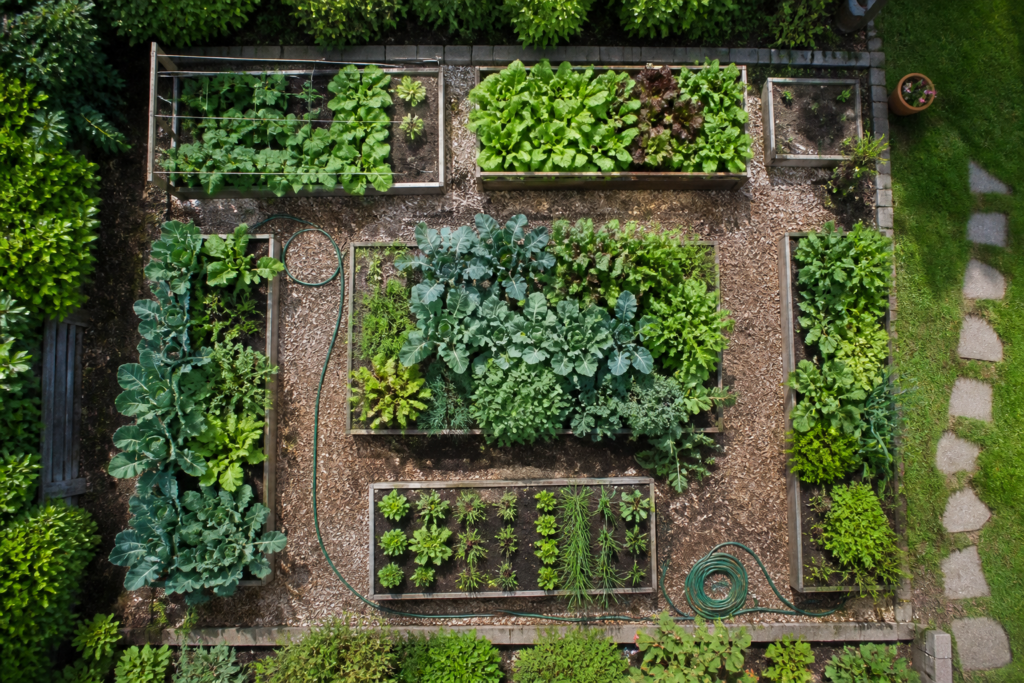
List each crop’s light, spacing, maturity, and support needs. Fast radishes can share early space with slower carrots; a trellised cucumber can use vertical room while shade-tolerant greens occupy the edge. Avoid pairing plants that demand very different watering or fertilizer.
Design for access
Keep paths clear and leave enough room to inspect stems and soil. Use taller crops on the north side where practical. Herbs and flowers can add habitat and harvest value, but do not let them crowd vegetable roots or block airflow.
Use timing and rotation
Succession planting creates useful partnerships: an early lettuce row can be followed by beans, while a spring pea trellis can be replaced with a fall crop. Rotate plant families when space permits, especially where soil-borne disease is a concern.
What companion planting cannot do
No pairing eliminates pests, poor soil, drought, or disease. Continue checking leaves, watering based on soil, and removing crop residue. If a plant repeatedly struggles beside a partner, separate them next season and compare results.
Companion planting is most useful as garden design, not as a promise that one plant will repel every pest or guarantee another crop’s yield. Traditional pairings can be enjoyable to try, but their results vary by site and should not replace spacing, rotation, sanitation, or crop-specific pest management.
Plan companions around real growing relationships
- Group plants with compatible sunlight, root space, water needs, and seasonal timing.
- Use tall crops or trellises deliberately to create shade only where a smaller crop can benefit from it.
- Avoid placing vigorous vines where they will overrun slower or shorter crops.
- Leave enough airflow and access to inspect leaves, water roots, and harvest without trampling plants.
- Use flowering plants at bed edges or nearby habitat areas to provide nectar and pollen for beneficial insects.
- Stagger quick crops such as radishes or greens between slower transplants only while their maturity windows truly fit.
- Rotate crop families between seasons to reduce recurring soilborne pests and nutrient imbalances.
- Do not crowd plants to create a companion combination; competition for light, water, and nutrients can outweigh any possible benefit.
- Keep records of what shared the bed, what weather occurred, and which problems appeared.
- Treat pest and disease problems based on identification and thresholds, not only on a companion-planting chart.
| Checkpoint | What to assess |
|---|---|
| Practical concept | How it helps |
| Crop diversity | Reduces a single-crop block and can support broader habitat. |
| Flowering habitat | Can support beneficial insects when timed and managed well. |
| Vertical growth | Uses space but must be positioned to avoid unwanted shade. |
| Succession timing | Lets a fast crop leave before a larger crop needs its space. |
Use traditional claims carefully
Many companion-planting lists make specific pest-repellent or growth-boost claims that are not reliable across gardens. Treat those claims as observations to test on a small scale, not as proven rules. The better-supported work is practical: give plants enough room, manage water and fertility, diversify the garden, and provide habitat for beneficial organisms.
A simple map of height, root space, and harvest timing is often more useful than a long list of supposed perfect plant partners.
Practical decisions for Vegetable companion planting
This guide works best when it supports a sequence of observations rather than a one-size-fits-all rule. Conditions vary by climate, soil, variety, container size, and season. Use the following prompts to narrow the next useful action.
- Traditional claims. Check this alongside the plant stage and recent weather before acting. A useful response should address the condition you observe, preserve access to the bed, and avoid creating a second problem through crowding, saturation, or unnecessary inputs.
- Crop diversity. Check this alongside the plant stage and recent weather before acting. A useful response should address the condition you observe, preserve access to the bed, and avoid creating a second problem through crowding, saturation, or unnecessary inputs.
- Beneficial insect habitat. Check this alongside the plant stage and recent weather before acting. A useful response should address the condition you observe, preserve access to the bed, and avoid creating a second problem through crowding, saturation, or unnecessary inputs.
- Flowering strips. Check this alongside the plant stage and recent weather before acting. A useful response should address the condition you observe, preserve access to the bed, and avoid creating a second problem through crowding, saturation, or unnecessary inputs.
- Spatial layering. Check this alongside the plant stage and recent weather before acting. A useful response should address the condition you observe, preserve access to the bed, and avoid creating a second problem through crowding, saturation, or unnecessary inputs.
- Vertical growing. Check this alongside the plant stage and recent weather before acting. A useful response should address the condition you observe, preserve access to the bed, and avoid creating a second problem through crowding, saturation, or unnecessary inputs.
- Light competition. Check this alongside the plant stage and recent weather before acting. A useful response should address the condition you observe, preserve access to the bed, and avoid creating a second problem through crowding, saturation, or unnecessary inputs.
- Water competition. Check this alongside the plant stage and recent weather before acting. A useful response should address the condition you observe, preserve access to the bed, and avoid creating a second problem through crowding, saturation, or unnecessary inputs.
- Nutrient competition. Check this alongside the plant stage and recent weather before acting. A useful response should address the condition you observe, preserve access to the bed, and avoid creating a second problem through crowding, saturation, or unnecessary inputs.
- Root space. Check this alongside the plant stage and recent weather before acting. A useful response should address the condition you observe, preserve access to the bed, and avoid creating a second problem through crowding, saturation, or unnecessary inputs.
- Succession timing. Check this alongside the plant stage and recent weather before acting. A useful response should address the condition you observe, preserve access to the bed, and avoid creating a second problem through crowding, saturation, or unnecessary inputs.
- Quick crops. Check this alongside the plant stage and recent weather before acting. A useful response should address the condition you observe, preserve access to the bed, and avoid creating a second problem through crowding, saturation, or unnecessary inputs.
- Rotation. Check this alongside the plant stage and recent weather before acting. A useful response should address the condition you observe, preserve access to the bed, and avoid creating a second problem through crowding, saturation, or unnecessary inputs.
- Disease management. Check this alongside the plant stage and recent weather before acting. A useful response should address the condition you observe, preserve access to the bed, and avoid creating a second problem through crowding, saturation, or unnecessary inputs.
- Pest identification. Check this alongside the plant stage and recent weather before acting. A useful response should address the condition you observe, preserve access to the bed, and avoid creating a second problem through crowding, saturation, or unnecessary inputs.
- Access. Check this alongside the plant stage and recent weather before acting. A useful response should address the condition you observe, preserve access to the bed, and avoid creating a second problem through crowding, saturation, or unnecessary inputs.
- Airflow. Check this alongside the plant stage and recent weather before acting. A useful response should address the condition you observe, preserve access to the bed, and avoid creating a second problem through crowding, saturation, or unnecessary inputs.
- Trial records. Check this alongside the plant stage and recent weather before acting. A useful response should address the condition you observe, preserve access to the bed, and avoid creating a second problem through crowding, saturation, or unnecessary inputs.
- Realistic expectations. Check this alongside the plant stage and recent weather before acting. A useful response should address the condition you observe, preserve access to the bed, and avoid creating a second problem through crowding, saturation, or unnecessary inputs.
Common mistakes and safer alternatives
Do not make a major correction from one visible symptom or one difficult week of weather. Compare several plants, inspect the root zone, and review what changed recently. When a product is considered, identify the problem first and follow its crop-specific label. Physical access, adequate spacing, steady water, and an appropriate planting window solve more garden problems than a routine of reactive products.
Seasonal review checklist
| Time | Useful check | Decision |
|---|---|---|
| Before planting | Light, soil condition, access, and forecast | Match the crop and method to the site. |
| Early growth | Emergence, spacing, moisture, and pest signs | Correct small problems before they spread. |
| Production | Water demand, harvest stage, and plant health | Maintain steady care rather than forcing growth. |
| After harvest | Residue, soil condition, and notes | Clear only what is needed and plan the next suitable crop. |
Frequently Asked Questions
Do marigolds protect every vegetable?
They can support beneficial insects, but they are not a universal pest shield. Monitoring remains essential.
Can I mix vegetables in rows?
Yes, when mature spacing, light, and water needs align and you can still reach the plants.
See crop-specific pairings through the Vegetable Gardening Advice hub.
