

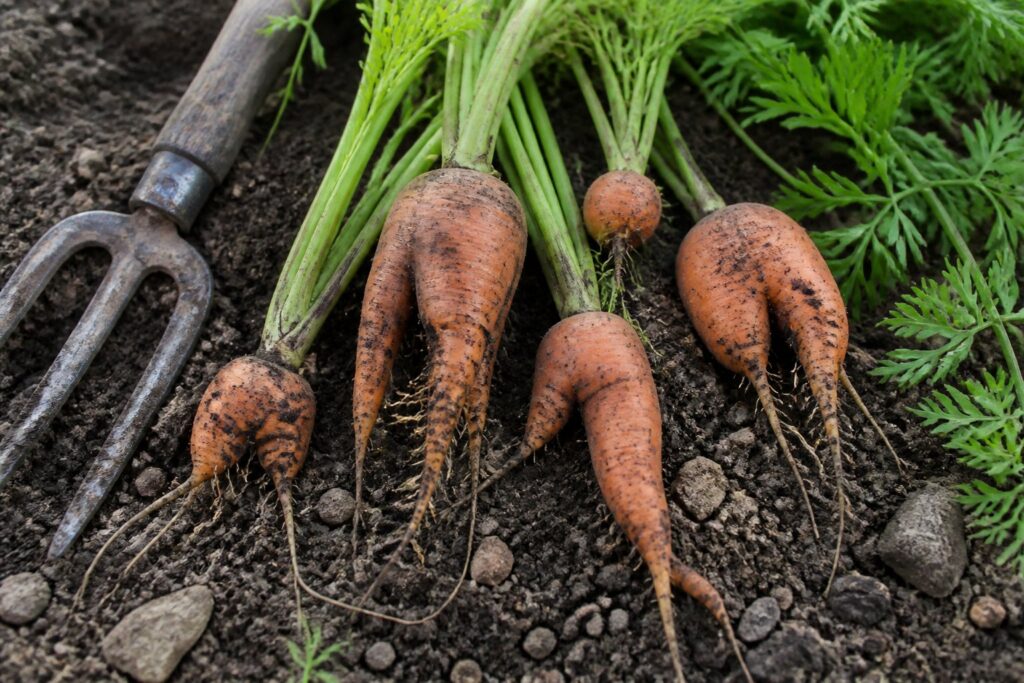
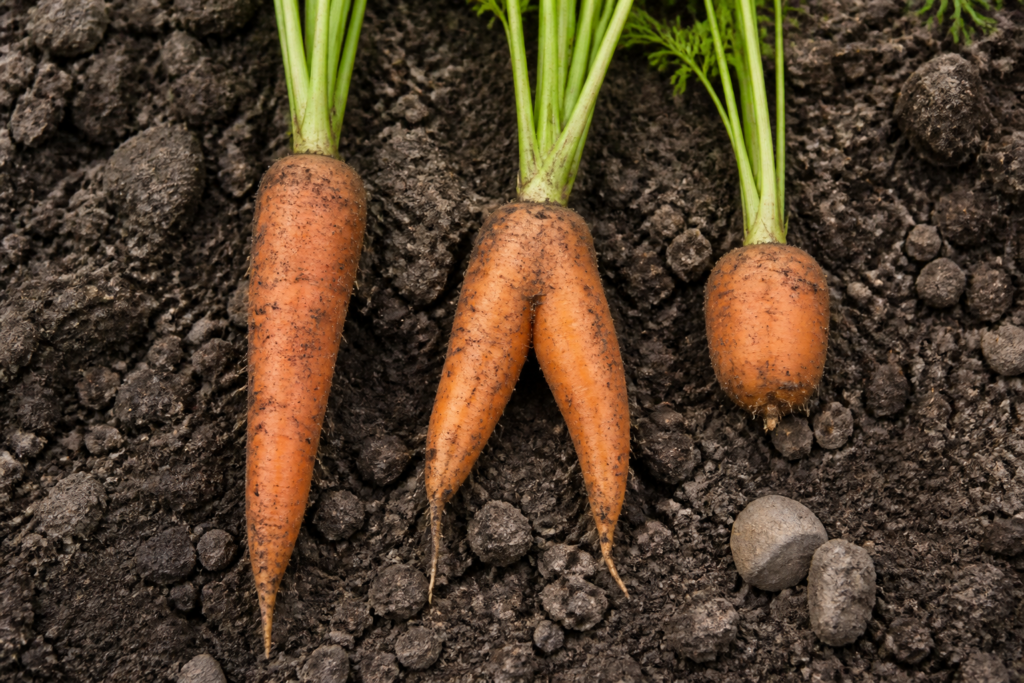
A forked, short, twisted, or oddly shaped carrot is rarely a mystery inside the seed. Most misshapen roots reflect what the young taproot met underground: a stone, a compacted layer, a clod, a pocket of unfinished organic material, inconsistent moisture, or crowding. The good news is that the roots are often still edible, and the next sowing can usually be improved with a few targeted changes.
Start by separating a cosmetic quirk from a crop-wide pattern. One crooked carrot in an otherwise good row is normal. A whole bed of stubby, branched, or cracked roots points to soil preparation, spacing, water management, or variety choice. This guide helps diagnose the pattern before changing everything at once. For seedbed fundamentals, return to Growing Carrots From Seed.
How carrot roots become misshapen
A carrot begins with one fine taproot. If the tip is blocked, broken, or repeatedly stressed while young, it may branch or stop extending normally. Later in the season, a mature root can also split as it expands through dry-to-wet cycles or meets a hard layer. Carrots are not a verdict on a gardener’s skill; they are a useful readout of the bed below the surface.
| Root shape | Common contributors | What to investigate |
|---|---|---|
| Forked or multiple legs | Rocks, clods, compaction, root injury, undecomposed material. | Dig a sample area and inspect soil at root depth. |
| Short or blunt roots | Shallow soil, dense subsoil, variety too long for the site, crowding. | Compare harvested length with loose soil depth. |
| Twisted or bent roots | Obstacle, hardpan, transplanting, irregular soil texture. | Look for stones, old roots, or compacted zones. |
| Cracked roots | Rapid water change after drought, delayed harvest, variety tendency. | Review recent weather and irrigation pattern. |
| Hairy or rough roots | Stress, excess moisture, injury, or a soil issue. | Check drainage and avoid overwatering. |
First check: the root zone, not just the surface
A bed can look beautifully loose on top while hiding a dense layer a few inches down. Before the next planting, push a trowel, garden fork, or soil probe into a few spots. If it stops abruptly, roots probably do too. Work the bed only when the soil is moist enough to crumble; digging wet soil can smear the sides of a planting trench and make compaction worse.
Remove stones and hard debris from the expected root zone. Break persistent clods rather than merely raking over them. If a native bed is shallow, heavily compacted, or full of gravel, a deep raised bed or a container with a suitable shorter carrot variety may be more practical than repeated attempts at long roots. The comparison in containers, raised beds, and in-ground beds can help match the method to the site.
Fresh manure and uneven organic matter
Organic matter can improve garden soil, but timing and texture matter. Finished compost mixed evenly through a bed can help with water-holding and structure. Fresh manure, chunky undecomposed material, or concentrated pockets of amendments are less predictable in a carrot row. Roots may branch around obstacles or grow unevenly through a patchwork of textures.
Plan amendments before the carrot crop rather than dropping rich material into individual planting holes. Carrots are direct-sown in a continuous bed, so consistent texture matters more than a nutrient “boost” beneath each seed. If a soil test indicates a nutrient need, use a product and rate appropriate to the result and follow the label. More fertilizer cannot solve a stone or compacted layer, and excessive feeding can emphasize leaves without fixing root quality.
Protect the young taproot
Carrots are normally grown from seed in place. Moving seedlings, thinning roughly, digging too close to tiny roots, or disturbing the row when soil is very dry can damage the developing taproot. The risk is not that every disturbed plant will fork; it is that transplanting and repeated disturbance add an avoidable variable to a crop that already prefers a quiet root zone.
Sow shallowly into fine soil, keep the surface moist while germination begins, and thin with care. If crowded seedlings are tightly intertwined, snip extras at the soil line instead of yanking them out. Once established, weed shallowly between rows and avoid driving a tool into the carrot line. The Carrot Spacing Guide explains how spacing reduces the need for aggressive thinning later.
Watering patterns that affect root quality
Carrots need moisture, but the goal is consistency rather than constant saturation. The seed zone should stay moist until emergence. After that, water deeply enough to reach developing roots, then let the soil approach normal moisture before watering again. A container may need attention much more frequently than a ground bed; heavy clay may need water less often but can drain poorly.
Problems can arise when a bed becomes very dry and then receives a sudden heavy soaking or storm. Expanding roots may crack, especially near harvest size. Persistently wet soil also limits air around roots and can stress plants. Check beneath the surface rather than judging only by a dry-looking crust. A handful of soil squeezed from the root zone should not drip water, yet it should not be dusty and crumbly like dry sand.
Spacing and variety choice matter
Crowded carrots compete for light, water, and room to enlarge. The result is often a row of thin roots rather than large forks, but crowding can make every other problem harder to see. Thin most standard types to roughly two to three inches apart unless the seed packet gives another finished spacing. In a narrow bed, use rows or a block layout that you can weed without stepping on the soil.
Variety also sets expectations. Long Imperator-style roots need more depth and a more open root zone than short Chantenay, Nantes, Parisian, or other compact forms. In a dense urban bed or container, choosing a shorter variety is not settling for less; it is matching a cultivar to the physical space. For timing and heat considerations that affect quality, see When to Plant Carrots.
Diagnose by pattern
Forked roots across the whole bed
Look for stones, compaction, chunks of undecomposed material, or a history of transplanting. Dig beside several carrots. If the soil is hard or lumpy at the same depth where roots split, preparation is the priority for the next sowing.
Short roots only in one area
That area may have a shallow layer, buried construction debris, a compacted path edge, or poorer drainage. Do not assume the entire garden needs rebuilding; compare a small soil pit in the poor spot with one in the better part of the bed.
Cracks after a hot, dry period
Review irrigation. Mulch, a watering routine based on soil checks, and harvesting within the variety’s window can reduce the extremes that encourage splitting. The roots remain usable if firm and sound; trim damaged portions and use them promptly.
Misshapes only among the largest carrots
They may simply have been left longer in a crowded, increasingly dry, or obstacle-filled bed. Harvest a few at different sizes next season rather than waiting for every root to become maximum size at once.
What not to do
- Do not pull every odd carrot as proof that the crop has failed. Taste and texture matter more than perfect supermarket shape.
- Do not add a heavy dose of fertilizer as a cure for compact soil.
- Do not transplant carrot seedlings to “fill gaps” in a row.
- Do not work wet soil into a finer texture; that can create the hard layer you are trying to avoid.
- Do not use one variety’s ideal length as the standard for every site.
A better next sowing
- Choose a variety suited to your available depth.
- Prepare a uniform, loose bed and remove obstacles.
- Direct-sow shallowly; do not transplant.
- Keep the seedbed moist until emergence, then water evenly through the season.
- Thin to final spacing and keep weeds from competing.
- Harvest a sample as roots size up, using the harvest guide to judge readiness.
Keep a simple root-shape record
At harvest, line up a few roots from each bed rather than judging one example. Note the variety, sowing date, root length, and the part of the bed where they grew. If forks appear only near a path, compaction is a better suspect than the seed. If short roots occur throughout a shallow raised bed, choose a shorter type or increase usable depth. This small record turns an odd harvest into information for the next sowing.
Make one change at a time when possible. For example, improve stone removal and use the same variety, or keep the bed preparation but change variety length. Changing soil, watering, variety, and spacing all at once makes it hard to learn which adjustment helped.
Frequently asked questions
Are forked carrots safe to eat?
Usually, yes, if the root is firm and free of decay. Scrub it well, trim damaged or tough parts, and use it like any other carrot. Shape is not a safety test.
Will adding sand fix heavy soil?
Not automatically. Small amounts of sand mixed into clay can create a denser, concrete-like texture. Improve structure gradually with organic matter, avoid compaction, and consider a raised bed or a shorter-root variety where needed.
Can pests cause misshapen carrots?
Root injury from pests can contribute, but soil obstacles, compaction, moisture swings, and disturbance are common explanations. Look for a pattern and inspect roots and soil before assuming one cause.
Explore the complete set of guides on the Growing Carrots hub.
